Search
Search for "click":
(Click here to search this entire website for "click" with Google.)
 |
|
|
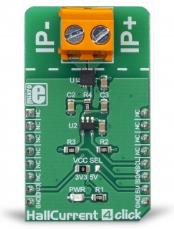
The Hall Current 4 click is designed to measure relatively high current by using the integrated ACS70331 sensor. The current sensor is based on the GMR elements for current measurement. The Hall Current 4 can be used for current measurement in the applications designed to follow a current, such as the applications for monitoring the current in battery chargers, or for the various kinds of system power supplies.
It comes in the package which also includes the mikroSDK™ software and a library with all the functions. The Click board™ comes as a fully tested and approved prototype, making it a reliable device ready to use on the development board.
|
|
|
|
|
|
|
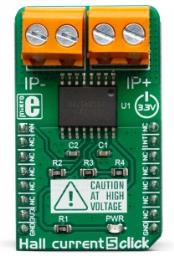
Hall Current 5 Click is a very accurate electric current measurement Click board™ based on the ACS733 IC. This IC is a galvanically isolated current sensor, which utilizes the Hall-effect principle. Its most distinctive feature is its very low series resistance of only 1 m?, which makes this device a nearly-perfect ammeter. The maximum current which can be measured with Hall current 5 click ranges from -20 A to +20 A, with the optimized precision. By using the latest manufacturing technologies, the ACS733 can be used on very high frequencies, making it a perfect solution for a wide range of applications.
Hall current 5 Click is supported by a mikroSDK compliant library, which includes functions that simplify software development. This Click board™ comes as a fully tested product, ready to be used on a system equipped with the mikroBUS™ socket.
|
|
|
|
|
|
|
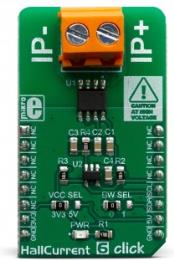
Hall Current 6 Click is a very accurate current measurement Click board™, based on the ACS723 IC. This IC is a galvanically isolated current sensor, which utilizes the Hall-effect principle. Its most distinctive feature is its very low series resistance of only 0.65 m?, which makes this device a nearly-perfect ammeter. The maximum current which can be measured with Hall Current 6 click ranges from -5 A to +5 A, with the optimized precision. It features a dedicated bandwidth selection pin, which allows better noise performance for a specific application.
Hall Current 6 Click is supported by a mikroSDK compliant library, which includes functions that simplify software development. This Click board™ comes as a fully tested product, ready to be used on a system equipped with the mikroBUS™ socket.
|
|
|
|
|
|
|
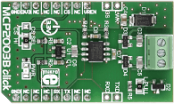
MCP2003B click is a mikroBUS add-on board with a bi-directional LIN transceiver.
It's a physical interface to automotive and industrial LIN systems, in accordance to the LIN Bus Specifications Revision 2.2, SAE J2602 and ISO 17987. This standard requires that all nodes in the system are to be connected through a LIN bus. Up to 15 slave devices can be connected to a single master.
The click has three onboard screw terminals for connecting the transceiver to a LIN network (three wires: LIN, VBB and GND).
MCP2003B click communicates with the target board MCU through the mikroBUS UART interface (RXD, TXD), with additional functionality provided by the VRENDIV and LWAKE pins. Extra pins for LWAKE, CS, and TX and RX are also available above the mikroBUS.
The board is designed to use a 3.3V power supply only. |
|
|
|
|
|
|
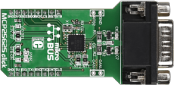
MCP25625 click is a mikroBUS add-on board carrying a Microchip CAN controller with an integrated transceiver. It meets the automotive requirement for high speed operation (up to 1 Mb/s).
Named after the main chip, MCP25625 click also has a RS232 port, which is a standard connector for CAN communications. Additionally, the two CAN wires (CANL and CANH) can also be connected directly through two pins on the right edge of the board.
The click communicates with the target MCU through the SPI interface - although there are additional options that take the load off the target board MCU. To that end, all 16 mikroBUS pins are connected. There's a clock output, a Request To Send, an Interrupt, standby, reset and more. MCP25625 click can work with both 3.3V or 5V logic levels. |
|
|
|
|
|
|
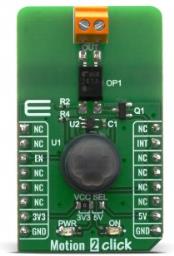
Motion 2 Click is a Click board™ based on EKMC1607112, PIR motion sensor from Panasonic Corporation that's used as human motion detector. Also featured on Motion 2 Click bord is TLP241A photorelay from Toshiba that is used to provide a reinforced galvanic isolation for the external signals used to drive some external high power electronic equipment when motion is detected. It's allowing up to 40V between the SSR contacts in OFF state, and currents up to 2A while in ON state, thanks to a very low ON-state resistance.
Motion 2 Click board™ is supported by a mikroSDK compliant library, which includes functions that simplify software development. This Click board™ comes as a fully tested product, ready to be used on a system equipped with the mikroBUS™ socket.
|
|
|
|
|
|
|
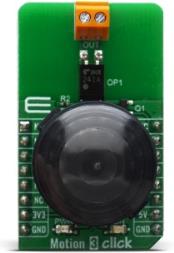
Motion 3 Click is a Click board™ based on EKMC1606112, PIR motion sensor from Panasonic Corporation that's used as human motion detector. Also featured on Motion 3 Click bord is TLP241A photorelay from Toshiba that is used to provide a reinforced galvanic isolation for the external signals used to drive some external high power electronic equipment when motion is detected. It's allowing up to 40V between the SSR contacts in OFF state, and currents up to 2A while in ON state, thanks to a very low ON-state resistance.
Motion 3 Click board™ is supported by a mikroSDK compliant library, which includes functions that simplify software development. This Click board™ comes as a fully tested product, ready to be used on a system equipped with the mikroBUS™ socket.
|
|
|
|
|
|
|
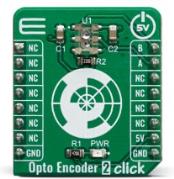
Opto Encoder 2 click is a linear incremental optical sensor/encoder click which can be used for the movement or rotation encoding. Encoders of this type are widely used for many applications, which involve precise detection of the position, speed, or rotational angle of an object. Rotary encoders are often used for various types of controllers on many different devices. Whether it be a rotary encoder knob controller or an angle encoder on a motor shaft, the principle is the same - it includes an optical sensor, just like the one found on Opto Encoder 2 click.
Opto Encoder 2 click is supported by a mikroSDK compliant library, which includes functions that simplify software development. This Click board™ comes as a fully tested product, ready to be used on a system equipped with the mikroBUS™ socket.
|
|
|
|
|
|
|
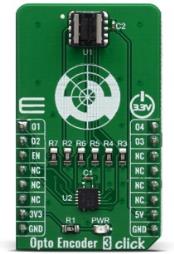
Opto Encoder 3 Click is a linear incremental optical sensor/encoder click, which can be used for the movement or rotation encoding. The TCUT1800X01 sensor is equipped with one infrared LED with the wavelength of 950nm, and four phototransistors. Encoders of this type are widely used for many applications which involve precise detection of the position, speed, or rotational angle of an object. Rotary encoders are often used for various types of controllers on many different devices. Whether it be a rotary encoded knob controller or a rotation encoder on a motor shaft, the principle is the same - it includes an optical sensor, just like the one found on Opto Encoder 3 click.
Opto Encoder 3 click is supported by a mikroSDK compliant library, which includes functions that simplify software development. This Click board™ comes as a fully tested product, ready to be used on a system equipped with the mikroBUS™ socket.
|
|
|
|
|
|
|
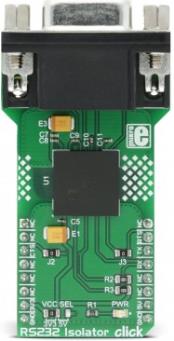
RS232 Isolator click is a fully isolated dual transceiver click, used to provide secure and easy UART to RS232 conversion, with the galvanic isolation. The digital input and output signals are transmitted across the isolation barrier by utilizing the Analog Devices proprietary iCoupler® technology - IC scale transformer windings couple the digital signals magnetically, from one side of the barrier to the other, providing the galvanic isolation and transfer rates up to 460Kbps.
RS232 Isolator click can be used for galvanic isolation of RS232 signals, whenever there is a need for that kind of isolation - operating in harsh environments where electrostatic discharges (ESD) can occur, when the RS232 cable is plugged in and out frequently, and generally - wherever the sensitive part of the RS232 controller logic circuitry needs to be protected. |
|
|
|
|
|
<< First
< Previous
Next >
|
|